Modern Alchemy and the Age of Custom-Cooked Software
March 23, 2026
Software is entering an era that feels less industrial and more alchemical.
For a long time, useful tools were local, improvised, and personal. People mixed remedies from what they had, learned from trial and error, and passed working knowledge around by experience more than by formal systems. Then industrialization arrived. Store-bought products won on scale, consistency, and convenience. They also flattened everything personal about the tools people used.
That same pattern played out in software.
For decades, the dominant model has been shrink-wrapped software, then SaaS: standardized products built for large markets, sold to broad categories of users, and optimized for repeatability. That model is not disappearing. But AI is changing the economics around it.
The cost of making custom software is falling fast.
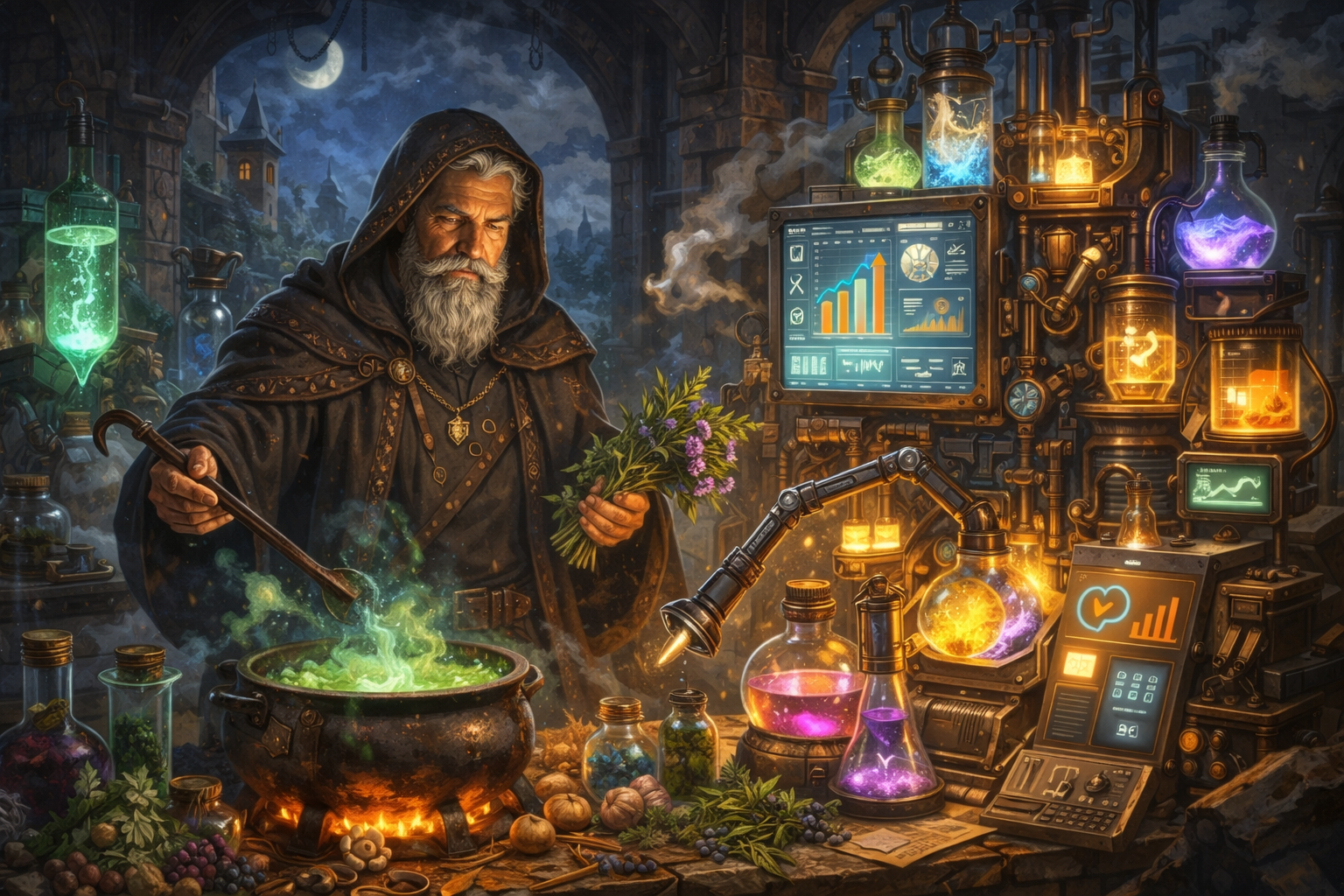
From Boxed Products to Personal Systems
The old tradeoff was simple: if you wanted custom software, you needed serious time, money, and technical skill. Most people accepted the constraints of mass-market tools because the alternative was too expensive.
A single motivated builder can now do work that used to require a small team: prototype interfaces, scaffold backends, wire integrations, refine copy, automate repetitive coding, and keep iterating without paying the full historical tax of custom development.
That does not mean capitalism is failing, or that software companies are about to vanish. It means the edge of the market is changing. There is now more room for software built for a family, a neighborhood, a church, a homeschool group, a small company, or a niche online community that has always been too specific to matter to a venture-scale SaaS firm.
The Return of the Tinkerer
This is the part that feels personal to me.
We are moving back toward a world where private operators and local tinkerers can make software that reflects their actual preferences instead of contorting themselves around generic workflows. Personal preference is becoming encodable again.
When software becomes easier to shape, people can build around the texture of real life:
- how their family plans meals
- how they manage money
- how they share calendars
- how they organize learning
- how a small trusted group communicates and makes decisions
Mass-market software tends to flatten those differences. Custom software can honor them. If you're shipping quickly and somewhat ferociously for your own family, you feel the value of that immediately.
The Infrastructure Is Catching Up
AI is not the whole story. A private software renaissance needs practical infrastructure, and that infrastructure is getting better.
Tools like Tailscale make secure connectivity vastly easier than the old VPN-and-port-forwarding era. Self-hosted platforms like Nextcloud, Plex, and Synology reduce the friction of running useful services at home or for a small group. Cheap cloud infrastructure and better local hardware give small operators options that used to belong only to companies with larger budgets and dedicated staff.
None of this removes the need for judgment, maintenance, or operational discipline. But it does lower the barrier to entry enough that more people can reasonably participate.
What Happens Next
Open source will benefit, because AI makes it easier for people to extend, adapt, and maintain existing tools instead of waiting for vendors to care about their use case. Personalized software will become a commodity in its own right: not one giant app for everyone, but many smaller systems shaped around specific people and contexts.
Large software products will remain. They solve real problems, and scale still matters. But they may face increasing pressure from a world where smaller, sharper, more personal tools are finally affordable to build.
Happy Shipping
It is a good time to be a tinkerer.
Software no longer has to be packaged for the masses to be valuable. It can be local, opinionated, built for your household, your friends, or the strange corner of life that only you understand well enough to model.
That is going to get better. Happy shipping.