The Arithmetic Doesn't Care
May 19, 2026
I'm a software engineer, not an economist. But I can do arithmetic. And the arithmetic coming out of Washington should bother anyone with a pulse and a savings account.
The US national debt crossed $39 trillion last week. The federal government will pay roughly $1 trillion in interest on that debt this fiscal year. That's $88 billion a month. $22 billion a week. More than the defense budget and the Department of Education combined, spent servicing past borrowing before a single new dollar goes to roads, schools, or veterans.
That number has tripled since 2020.
The Trap
The Federal Reserve held rates at 3.50-3.75% at its April meeting. The vote was 8-4, the most fractured since 1992. Markets are pricing in zero cuts for 2026. Some traders see a 40% chance of a rate hike before year-end.
But the Fed can't hike. Not with $39 trillion in outstanding debt and a third of it rolling over within twelve months. Every 25 basis points added to the federal funds rate translates to roughly $97 billion in additional annual interest cost as maturing debt reprices. A full percentage point adds nearly $400 billion. The Congressional Budget Office already projects interest payments doubling to $2.1 trillion by 2036 under current rates.
The Fed also can't cut. CPI hit 3.8% in April, the highest since May 2023. Energy costs jumped 17.9% year-over-year. Gasoline is up 28%. The Iran conflict closed the Strait of Hormuz and global oil is trading above $100. Cutting rates into that inflation print would torch whatever credibility the central bank has left.
So the Fed sits. Rates stay frozen. Inflation runs. And the bond market does whatever it wants.
The Bond Market Is Doing Whatever It Wants
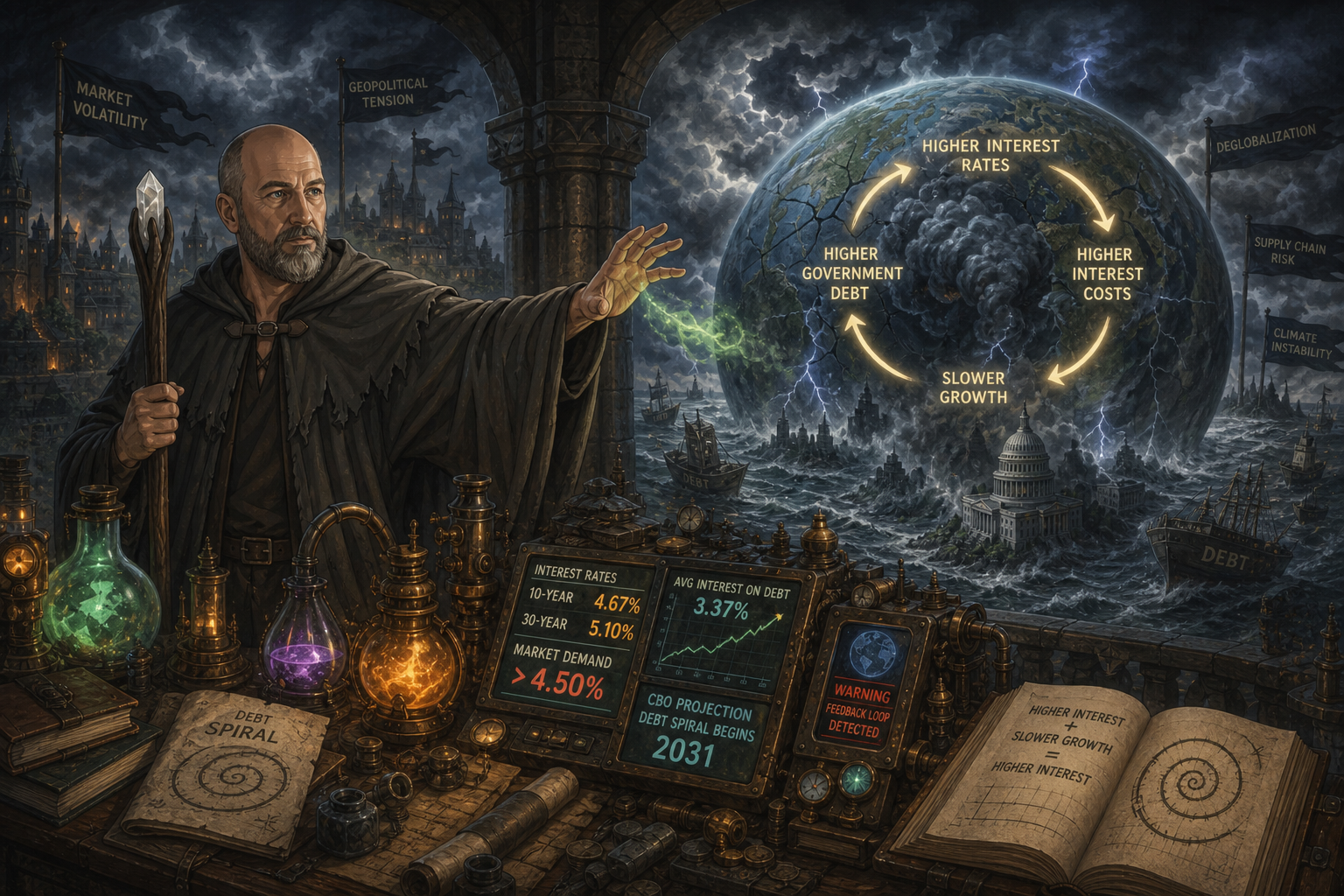
The 10-year Treasury yield touched 4.67% this week, near its highest in over a year. The 30-year crossed 5.1% last Friday. These are market-set rates, beyond the Fed's direct control, and they determine what the government pays when it refinances debt.
The average interest rate on total marketable US debt is 3.37%. The market is now demanding 4.5% or more. Every month, billions in older, cheaper debt matures and gets replaced with new issuance at today's higher rates. The blended cost grinds upward whether the Fed moves or not.
The CBO has a term for where this leads. They call it a "debt spiral": when interest costs push rates higher and depress growth, and depressed growth further increases interest costs. Their projections show it could begin by 2031.
It's Not Just Us
This is the part that moved me from mildly concerned to writing this post.
Japan's 10-year government bond yield hit its highest since 1997. Their 30-year yield reached a level never recorded in the data going back to 1999. Germany's 10-year bund hit a 15-year high. UK gilts haven't been this expensive since the 2008 financial crisis.
Sovereign bonds across the developed world are selling off at the same time. That's not one country with a spending problem. That's a global repricing of government debt as an asset class.
Japan matters because it's been running the debt playbook longer than anyone. Debt-to-GDP above 250%. Decades of yield curve control. A central bank that owns half the bond market. And even Japan is losing control of its long end, with three BOJ board members now pushing for rate hikes as inflation from the energy crisis forces their hand.
Japan has also been the world's source of cheap capital for decades. Institutions borrow yen at low rates to invest in US Treasuries and global risk assets. When Japanese yields rise, that trade unwinds. Foreign holders sell US bonds to buy domestic Japanese debt at better rates. That selling pushes US yields higher, which worsens our fiscal math, which prompts more selling.
The feedback loop is live.
What History Says Happens Next
Governments caught in this trap have three options. Default, austerity, or debasement.
No reserve-currency nation will default on debt denominated in its own currency. Congress will not pass meaningful spending cuts against Social Security, Medicare, or defense. That leaves the third door.
Debasement means keeping interest rates below the rate of inflation for an extended period. Your savings account earns 4% while prices rise 5%. The government's debt shrinks in real terms. Your purchasing power pays for it. Economists call this "financial repression." It's how the US and UK managed their post-World War II debt loads. It worked. It also took decades and quietly transferred wealth from savers to borrowers on a massive scale.
The more dramatic version is yield curve control, where the central bank directly caps long-term bond yields by buying unlimited quantities of government debt. Japan did this for years. The Bank of Japan's balance sheet ballooned to over 100% of GDP. It held the line on yields until it couldn't.
The Fed hasn't announced anything like this. But Treasury Secretary Bessent has been vocal about managing borrowing costs, and incoming Fed Chair Kevin Warsh takes the helm in June with an unusually divided committee and no good options.
Why I Care
I build software for my family. I think about systems. When I see a system with a feedback loop that has no stable equilibrium, no circuit breaker, and no political will to intervene, I pay attention.
A trillion dollars a year in interest is money that doesn't build bridges, fund research, or educate kids. By 2036, one out of every four federal tax dollars will go to creditors. That's the CBO's projection under current law, before any new spending, any new war, or any recession that blows out the deficit further.
I'm not predicting collapse. The US economy is resilient, productive, and still the destination for global capital. But resilience isn't the same as invulnerability. And "it hasn't broken yet" is not a fiscal strategy.
What You Can Do
I don't have policy prescriptions. I'm one engineer with a blog and a family to feed. But I know what I'm doing:
Paying attention to what my government owes and what it costs to service that debt. Understanding that inflation is a policy choice as much as an economic event. Holding assets that don't depend on a government's promise to repay. Teaching my kids that a dollar earned today may not buy the same thing tomorrow, and that's not an accident.
The arithmetic doesn't care about elections, party loyalty, or cable news narratives. It just compounds.
Watch the 10-year yield. Watch the interest payments. Do your own math.