The Beacons Are Lit
October 29, 2026
I haven't posted in a while. October gave me a reason.

In one week, a certificate authority learned its private keys could be guessed, PHP shipped emergency patches for two unauthenticated remote code execution bugs that attackers were already using, a 16-year-old flaw in firmware network boot code went public three months ahead of schedule, and Tailscale, the tool I told you to install back in March, patched Tailscale SSH flaws that let a trusted device climb to root on the servers it could reach.
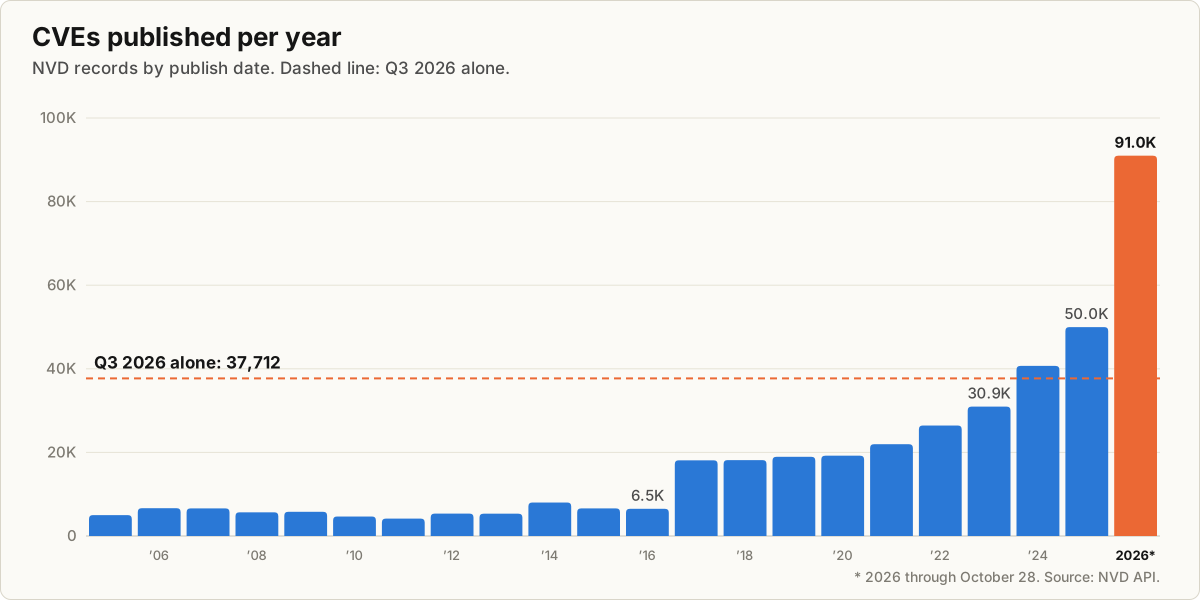
The numbers behind the headlines are worse. NVD published 37,712 CVEs in Q3 2026, more than in any full year before 2024. Through October 28 the year stands at 90,985, more than the ten years from 2009 through 2018 combined. Two separate analyses found NVD attached a severity score to about 8% of Q3's new records, so the feed you'd use to triage is blank for most of them. One analysis counted AI-credited CVEs rising from 34 to 769. Researchers and their AI tools are finding bugs faster than anyone can grade them.
When the beacons of Gondor lit up one after another across the mountains, nobody in Rohan needed a briefing on what it meant. October felt like that, one fire after another.
What Happened in October
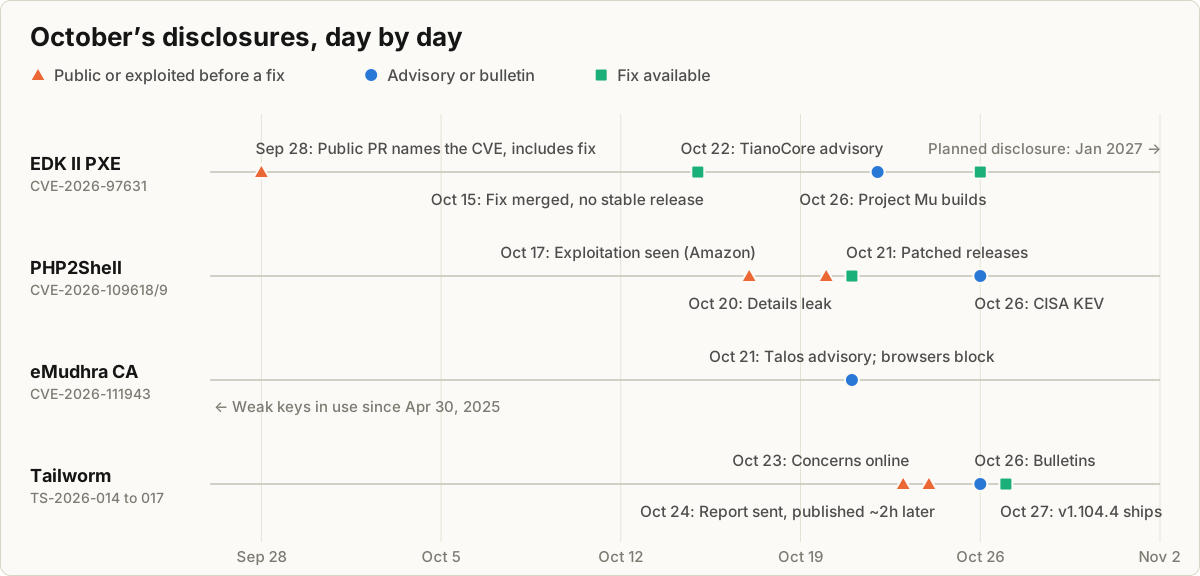
Four stories, one pattern: in three of them, the bug went public or got exploited before a fix shipped.
eMudhra's Keys
eMudhra, an Indian certificate authority, ran a key ceremony on April 30, 2025 with a bug in its key wrapping step. Eight intermediate CA certificates came out with private keys picked from single- and double-digit integers. Cisco Talos published on October 21, 2026. Anyone holding those keys could mint certificates your machines would trust.
Chrome, Firefox, and Apple blocked the intermediates, and Microsoft blocked the two used for code signing, so your browser updated itself. Go programs verify chains on their own and needed a rebuild on Go 1.26.10 or 1.27.3. Java and Python shipped their own denylists. VPN clients, reverse proxies, and IoT gadgets with a CA bundle baked into firmware each need their own fix, and some will never get one. No one has reported the keys used in the wild yet.
PHP2Shell
CVE-2026-109618 and CVE-2026-109619 are memory corruption bugs in PHP itself, reachable without authentication and scored 9.2. Researchers at Calif first spotted them in 2024 and judged them unexploitable. This year they found a way, with some help from AI, and took it to the PHP Foundation under embargo.
Disclosure was set for October 22. Details leaked on the 20th and patches landed on the 21st (8.5.12, 8.4.27, 8.3.36, 8.2.35). Amazon says it saw exploitation on October 17, four days before anyone could patch. CISA added both to its Known Exploited Vulnerabilities catalog on the 26th.
One vendor reports an actor chaining PHP2Shell with Fragnesia, a Linux kernel local root bug with public exploit code, to take over 25 servers. I haven't seen a second source confirm it, but the chain is textbook. The web bug gets the attacker a shell as www-data. The kernel bug gets them the box. Fragnesia was patched in May, and Copy Fail before it in April shipped with an exploit that fit in ten lines of Python. Any server that hasn't rebooted into a new kernel since spring is waiting for someone to try.
A Boot Flaw That Leaked
CVE-2026-97631 lives in the PXE driver of EDK II, the open source UEFI code that commercial firmware builds on. A crafted ICMP error during network boot overflows a 504-byte buffer. In the worst case an attacker runs code before Secure Boot checks anything. The bug is 16 years old.
Researchers from Anthropic and Google found it and planned disclosure for January 2027. On September 28 an engineer at AMI, a firmware vendor, opened a public pull request that named the CVE and included the fix. TianoCore published its advisory on October 22 with no patched stable release. Intel says none of its supported products carry the bug, and the other firmware vendors hadn't said much at last check.
The attacker has to sit on your local network while the machine netboots, so this isn't an internet-wide fire. It shows how disclosure works now: the fix itself is the leak, and the patch for your motherboard depends on a vendor who may never ship one.
Tailworm
This one stung. Tailscale says it received a report from Erica Windisch of Cyberdione Labs on the morning of October 24, and the researcher published it about two hours later: eleven findings across Tailscale and headscale. The worst, TS-2026-014, let a device already allowed to SSH into a server use socket forwarding to reach root-only sockets like Docker's, and take root from there. Hop to the next server and repeat.
Tailscale shipped 1.104.4 within three days, with four bulletins, TS-2026-014 through TS-2026-017. Headscale users were still waiting on parts of it at last check.
In fairness to Tailscale, none of this let an outsider into a tailnet. The attacker needed a foothold on a peer the policy already trusted. That is the lesson, though. Earlier this year TS-2026-006 and TS-2026-009 let SSH users reach root in violation of ACLs. If your policy says every device can SSH everywhere, one compromised laptop hands over the kingdom.
So What Does a Home Operator Do?
Stay the course. I stand by what I wrote in March: install Tailscale and close your public ports. An identity-aware mesh beats a port forward to a NAS admin panel every day of the week. Tailworm should change how much you trust the inside of the wall.
Nobody reads 37,000 CVEs a quarter, and NVD isn't scoring most of them anyway. Stop chasing the feed and track your own surface: what you run, what it listens on, who can reach it, and how fast it gets patched.
Automatic Updates, and Proof They Run
On Debian and Ubuntu, turn on unattended-upgrades and read the log to confirm it does something:
sudo apt install unattended-upgrades
sudo dpkg-reconfigure -plow unattended-upgrades
tail /var/log/unattended-upgrades/unattended-upgrades.log
A new kernel does nothing until you reboot into it. A box with 200 days of uptime is running a kernel from before Fragnesia's fix, so schedule the reboots. Docker images don't update with apt; a container pinned to php:8.3 gets the PHP2Shell fix when you pull and recreate it. Turn on Tailscale's own updater with tailscale set --auto-update. On Linux hardware that LVFS supports, fwupdmgr get-updates will tell you about firmware.
Read Your Tailnet Policy
Open the access controls page and read it as an attacker would. If you never edited the defaults, every device can reach every other device. Does your teenager's phone need SSH to the basement server? Does any device need root over Tailscale SSH?
Tag your servers, limit SSH to the people who administer them, keep them off root, and use check mode so a stolen device alone isn't enough:
"ssh": [
  {
    "action": "check",
    "src":    ["group:admins"],
    "dst":    ["tag:server"],
    "users":  ["autogroup:nonroot"]
  }
]
If you don't forward ports or sockets over Tailscale SSH, set TS_SSH_DISABLE_FORWARDING=1 in the tailscaled environment. Tailscale says it blunts several of the Tailworm findings.
Count Your Open Doors
Log into your router and list every port forward. Turn off UPnP unless something needs it, since UPnP lets any device on your LAN open a port without asking you. Then look from the outside: scan your public IP from a phone hotspot, or search it on Shodan to see what the internet sees. On each server, sudo ss -tlnp shows what's listening.
A port forward to a LAN machine puts that machine, and everything it can reach on your network, one bug away from strangers. A PHP app behind a port forward was a PHP2Shell target on October 17. If you must expose something, put it on its own VLAN or a box that holds nothing you'd miss, put a reverse proxy in front, and patch it first.
A VPS Is a Trade
The reflex answer is to move the app to a $5 VPS. That box has a public IP and gets scanned within minutes of booting, so you've exposed a port to the internet on someone else's hardware. Your family's photos, finances, and calendar now live on a rented disk under a provider's terms. Sometimes that trade is right. Make it on purpose.
Audit Users and Sudo
Who has accounts on your boxes, and what can they do?
getent group sudo docker
sudo -l -U someuser
Membership in the docker group is root under another name, and Tailworm's worst chain ran through the Docker socket. Delete accounts nobody uses. Remove the passwordless sudo rule you added at 1 AM to get something working. Clean authorized_keys of keys from laptops you sold.
Know When You're In Over Your Head
Running an app for five family members over a tailnet is a reasonable hobby. My family's apps run that way. Running an app for thousands of strangers on the open internet is a job: patch windows measured in hours, logs someone reads, backups someone tests, and a plan for the day you get breached. Attackers had PHP2Shell four days before a patch existed. A solo operator serving thousands has to be ready for that week.
I build with agents, and I'm a fan. They can wire up a payment integration in an afternoon. That doesn't make the person prompting them able to defend it. If you can't say what your app does when a dependency drops a 9.2 at 2 AM on a Wednesday, you aren't ready to hold strangers' data, and a vibe-coded SaaS with a login page doesn't change that math.
Agents Help, to a Point
Point your agent at your sshd_config, your tailnet policy, your reverse proxy config, and the ports: lines in your compose files. It will catch plenty, and it beats reviewing alone.
It has a ceiling. Anthropic and OpenAI gate offensive security work behind verification programs, the Cyber Verification Program and Trusted Access for Cyber, and researchers report models refusing to build proof-of-concept exploits even in authorized labs. I understand why. People at those same labs are finding bugs like the EDK II flaw. But the home operator ends up with a reviewer, not a penetration tester, and nothing stops an attacker from running an open-weight model with no guardrails at all.
You Are Not Alone
There's no single answer here. It's all of the above, done every month: updates that run, reboots that happen, a tailnet policy you've read, ports you can account for, a short list of users with sudo, and honesty about what you can operate. Most of it takes an evening, and you repeat the evening every month.
The beacons are lit, and the good news from the story holds: Rohan answered. Tailscale shipped a fix three days after a no-notice disclosure. The PHP Foundation and the distros pushed builds the day the embargo broke. Talos, CISA, and a lot of unpaid researchers spent their October on this. It's a brave new world out there, with no easy answers anywhere.
You are not alone on the wall.